FRAN Long Read
An interview with William Allchorn
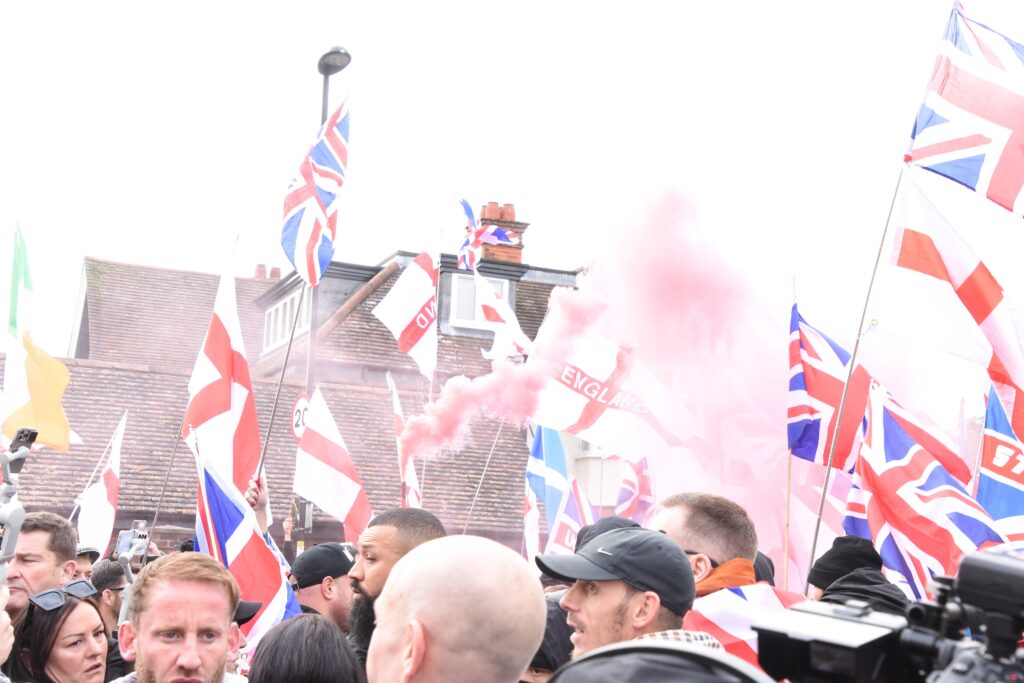
Following another wave of anti-migrant unrest in Belfast, we spoke with extremism scholar Dr William Allchorn about whether Britain has entered a new era of far-right mobilisation, the role of online myths and memes, the future of counter-extremism policy, and what his forthcoming case study article argues about engaging with far-right sympathetic audiences ethically.
Q: So there was recently another round of anti-migrant rioting in the UK, this time in Belfast. Can you give us an update on what’s going on right now in terms of how tense things are, generally speaking?
Dr William Allchorn: The immediate street violence has subsided, but I would describe the wider situation as calm rather than settled. The riots in Belfast in June followed the circulation of graphic footage of a stabbing allegedly committed by a Sudanese asylum seeker. What began as anger about a specific crime was rapidly collectivised and racialised, with houses, vehicles and businesses associated with migrant communities being attacked. More than two dozen residents reportedly had to be displaced, while a number of police officers were injured.
There are also signs that this was not entirely spontaneous. Community organisations had reportedly warned the police for months about online threats and lists of addresses associated with migrants or houses in multiple occupation. Some of those locations were subsequently targeted. That suggests an existing mobilisation infrastructure onto which a triggering incident could be grafted.
The atmosphere remains volatile. On 9 July, a replica mosque bearing anti-Islam and anti-immigration messages was burned on a loyalist bonfire in Moygashel. That illustrates the continuing interaction between anti-migrant politics, anti-Muslim hostility and Northern Ireland’s established traditions of territorial and sectarian mobilisation.
At the same time, thousands of people attended anti-racism demonstrations after the riots, so we should not mistake the rioters for Northern Irish society as a whole. The best characterisation is therefore one of significant underlying tension: the violence has reduced, but the narratives, networks and local grievances capable of producing another outbreak remain active.
Q: There were anti-migrant riots after the Southport stabbing in 2024, widespread protests last year against immigrant hostels and a violent protest last month at the Digwa sentencing. It seems like there’s a “new normal” of large-scale, far-right rioting now. Would you say that’s true?
Dr William Allchorn: I would be slightly cautious about calling rioting itself the “new normal”, because that can make violence appear inevitable or more universally supported than it is. In normal times, most anti-immigration demonstrations do not become riots, and most people who are concerned about migration do not participate in political violence.
What may have become normalised in the UK, however, is a recurring mobilisation repertoire. A serious crime or emotionally charged event takes place; incomplete, misleading or highly selective information circulates online; the event is framed as proof of a broader racial, religious or immigration-related threat; established influencers amplify that interpretation; and local protests are organised before verified information or judicial processes can catch up.
Southport demonstrated this very clearly. False claims that the attacker was a Muslim asylum seeker spread immediately and helped turn a horrific crime into a national anti-migrant mobilisation. The 2026 Belfast unrest followed a related pattern, although in that case the suspect’s immigration background was not fabricated. The critical point is that the alleged actions of an individual were used to justify violence against an entire category of people.
The protest following Vickrum Digwa’s sentencing for the murder of Henry Nowak also showed how a genuine and appalling crime can be “hijacked” by political actors. Digwa had falsely told police that he had been racially abused, and the circumstances understandably generated public anger. But the subsequent violence went beyond legitimate demands for accountability or scrutiny of the police response, and even ignored the wishes of Nowak’s family who called for the tragedy of their son’s death “ not used to inflame division or hostility”.
Research into the 2024 riots found that the online networks feeding this type of mobilisation pre-dated the triggering event and operated across multiple platforms, localities and political topics. I would therefore describe the new normal not simply as “far-right riots,” but something broader that has emerged. In particular, this is what Nigel Copsey has recently described as a shift in Britain’s far right “from violent, extra-parliamentary protest to decentralised, non-violent cultural-symbolic activism that weaponised national identity through flags, heritage and territorial marking”. This is more that just a movement but also a persistent riot-capable ecosystem: decentralised online networks, grievance entrepreneurs, local protest infrastructures and a political climate in which individual crimes can quickly be transformed into collective accusations.
That does not make disorder unavoidable. It does mean that policymakers should stop treating each outbreak as an isolated public-order emergency and think about the through-lines, online ecosystems and repertoires that are enabling these sorts of pogroms to take place on a regular basis.
Q: You recently reviewed Ashton Kingdon’s new book, The World White Web. Can you take us through what this book offers an audience interested in present trends?
Dr William Allchorn: One of the principal contributions of Ashton Kingdon’s The World White Web is that it asks us to take visual propaganda seriously. Far-right communication is not limited to manifestos, speeches or explicitly ideological texts. It increasingly operates through memes, symbols, historical images, screenshots, jokes and apparently nostalgic or ironic cultural material.
The book is based on an analysis of approximately 20,000 memes and brings together criminology, history and computational methods. It shows that contemporary white-supremacist propaganda may appear highly modern in its format while drawing upon much older mythologies, racial hierarchies and interpretations of history.
That is particularly useful because memes are frequently treated as politically insubstantial or dismissed as humour. Yet their ambiguity is precisely part of their utility. A meme can communicate an exclusionary worldview while allowing the person sharing it to retreat into claims of irony: “It was only a joke,” or “You are reading too much into it.” It can also compress a complex ideological proposition into an image that is immediately legible, emotionally resonant and highly reproducible.
The book helps readers understand the mythical dimension of far-right propaganda: narratives of civilisational decline, racial replacement, masculine restoration, heroic ancestry, lost homelands and national rebirth. These are not necessarily myths in the narrow sense of something entirely invented. They are selective and emotionally charged stories through which contemporary events are organised and given political meaning.
I described the book as theoretically robust and essential reading for those studying online radicalisation, visual culture, digital media and political extremism. Its broader lesson is that researchers and practitioners cannot understand present-day radicalisation by analysing words alone. We have to understand the image-stream and the cultural references through which ideology is made attractive, humorous, participatory and shareable.
Q: Your new SAGE publication, Countering Hate Ethically: Inclusivity and Sensitivity in Engaging Far-Right Sympathetic Audiences, is out very soon. Can you give us an idea of the theory you present?
Dr William Allchorn: The central argument is that countering hate is not only a question of whether an intervention is effective. It is also a question of whether the intervention is ethically designed, ethically delivered and ethically evaluated. The case study grows out of my pilot research testing online counter-narratives with audiences displaying sympathy towards far-right ideas. A fundamental problem in this area is that practitioners can approach such audiences either as enemies who must be defeated or as passive subjects who must be manipulated. Neither position is particularly conducive to sustained attitudinal change.
An ethical approach – and the theory of change underpinning the research – was to begin by distinguishing between hardened ideological activists, individuals expressing prejudice, people motivated by anxiety or perceived insecurity, and people who may simply have encountered misleading information. Treating all of these audiences as equivalent risks further stigmatising individuals and can reinforce the far right’s claim that mainstream institutions regard ordinary citizens with contempt.
In this case, however, inclusivity does not mean validating racist or conspiratorial claims. It means recognising the social and emotional position from which a person is speaking and allowing space for agency, dialogue and change. Sensitivity means avoiding interventions that humiliate participants, unnecessarily reproduce harmful material, expose vulnerable communities to further abuse or collect personal information without appropriate safeguards.
The practical implication is a form of proportionate engagement. Counterspeech should be specific to the underlying stereotype or grievance, credible to the intended audience and clear about its normative boundaries. It should offer alternative explanations and identities rather than merely denouncing people as hateful. Recent research elsewhere has similarly found that counterspeech addressing the specific assumptions beneath a stereotype is generally more convincing than generic moral condemnation.
Evaluation also has to go beyond clicks and immediate message approval. We need to ask whether an intervention reduces hostility, increases reflection, changes behaviour or simply causes participants to conceal their views. In that sense, ethics is not an optional constraint placed upon effectiveness. Ethical legitimacy is part of what makes engagement credible and potentially effective in the first place.
5. Your 2018 book, Anti-Islamic Protest in the UK: Policy Responses to the Far Right, has become an important text in the field. Has the UK adapted its policy approaches since then, or is it still lagging behind?
There has certainly been adaptation. When I wrote the book, one of the central concerns was that responses to anti-Islamic street movements were fragmented. Police forces, local authorities, national security bodies and community organisations often understood the same movement in very different ways. Some treated it primarily as a public-order issue, others as a terrorism problem, and others as a matter of community cohesion.
Since then, the state has developed a more explicit vocabulary around extreme-right-wing terrorism, and Prevent guidance now recognises cultural nationalism, white nationalism and white supremacism as overlapping ideological categories within extreme-right-wing terrorism. There has also been greater professional awareness of online mobilisation, lone-actor violence and the relationship between non-violent extremist milieus and more overtly violent actors.
Nevertheless, I think the UK continues to lag behind in several respects.
First, policy is still institutionally compartmentalised. Counterterrorism, public-order policing, hate-crime policy, online regulation and social cohesion are frequently treated as separate domains. Contemporary far-right mobilisation moves freely across all five.
Second, policy remains overly event-driven. Resources and political attention increase after an attack or riot and then decline once the immediate crisis passes. The warnings reportedly given before the Belfast riots demonstrate the limitations of that approach.
Third, there is still an inadequate policy framework for activity that is harmful and radicalising but does not cross the threshold into terrorism or criminal incitement. We should not criminalise lawful political opinion, including views on immigration, national identity and the like. But neither should we assume that anything below the terrorism threshold is irrelevant to the development of violence.
Finally, policy has to become more locally differentiated. The dynamics of an English Defence League-style mobilisation in an English town are not identical to loyalist mobilisation in Northern Ireland, even when some of the anti-Muslim or anti-migrant narratives overlap. National expertise needs to be combined with sustained local knowledge, trust and community engagement. There are great organisations (like the Local Government Association’s Special Interest Group on Countering Emerging Threats (SIGCE)) but these are usually rare and exceptional.
Q: A lot of people see these outbreaks of violence and the rise of Reform and conclude that Countering Violent Extremism and Prevent have failed. Would you agree?
I would not accept that conclusion in such a simple form.
Prevent is intended primarily to prevent individuals from becoming terrorists or supporting terrorism. It is not an all-purpose programme for preventing prejudice, electoral support for populist parties, hostile public attitudes towards migration or every episode of collective disorder. Reform UK’s electoral rise cannot, in itself, be treated as evidence of counterterrorism failure. In a democracy, support for a lawful political party has to be addressed through democratic politics.
There are, however, legitimate criticisms to be had of current UK counter-terrorism policies and interventions. For example, the Southport perpetrator had previously come into contact with Prevent, and subsequent reviews identified lessons concerning risk assessment, information sharing and the treatment of individuals whose fixation on violence did not fit neatly into a conventional ideological category. The government published a further response to those lessons on 2 July 2026. Official data also show that Prevent continues to receive a substantial and ideologically diverse caseload. The existence of later violence does not prove that the programme has achieved nothing: successful prevention is inherently difficult to observe because the attacks that do not happen rarely become public knowledge or are precisely that: a counter-factual that we’ll never know about.
The more persuasive criticism is that Britain has sometimes asked Prevent to compensate for weaknesses elsewhere. A counterterrorism referral system cannot substitute for adequately funded youth services, mental-health provision, community policing, digital literacy, local conflict prevention or credible political communication about migration. We also need to distinguish violent extremism from a much larger radical-right milieu. Only a small proportion of people consuming conspiratorial or anti-migrant material will meet the threshold for Prevent. Nevertheless, that wider environment may legitimise hostility, circulate target information and provide the audience from which violent actors emerge.
My view would therefore be that Prevent has neither simply succeeded nor simply failed. It remains necessary but insufficient. Its performance should be scrutinised, but it should be situated inside a much broader prevention architecture rather than expected to resolve every manifestation of political and social polarisation.
Q: Last time, we discussed Starmer shifting Labour to the right on a number of social issues and conceding positions he did not need to concede. Do you think a party led by Andy Burnham will do better?
Dr William Allchorn: The first point to clarify is that at the time of this interview, as of 15 July 2026, Andy Burnham has not yet formally become Labour leader or prime minister. It is therefore too early to judge a Burnham government, and I would be cautious about treating style or rhetoric as proof of substantive change on the rights of LGBQT+ individuals and community in the UK.
I think that Andy Burnham may be better positioned to articulate a communitarian and materially grounded response to the radical right. His political identity has been closely associated with regional government, public services, transport and the idea that political alienation has economic and geographical foundations. His emerging “Manchesterism” agenda has emphasised infrastructure, housing, skills and decentralisation. Those themes potentially offer an alternative to simply mirroring Reform’s framing of migration and national decline.
The key test, however, will be whether he can discuss migration in a way that combines competence, control and procedural fairness without adopting the far right’s underlying account of migrants as a civilisational threat. Nearly 80 Labour MPs have already urged him to move away from hostile rhetoric and to address both the desire for an orderly system and the demand for compassion and rights.
The strategic danger for centre-left parties is that conceding their radical-right opponents’ diagnosis rarely neutralises the issue. It may instead increase the salience of immigration, legitimise more exclusionary premises and encourage voters to choose the party perceived as owning the issue. At the opposite extreme, simply dismissing public concern as prejudice can deepen resentment and political distrust.
A more effective approach would connect migration policy to housing supply, labour-market enforcement, regional investment and functional public services. It would distinguish legitimate disagreements over migration levels from conspiracy theories, racial scapegoating and intimidation. It would also defend pluralism confidently rather than apologetically.
Burnham may have a greater opportunity than Starmer to develop that type of “principled” approach to the far right, particularly because of his regional record and political style. But whether he actually does so will depend upon appointments, policy choices and the language used during future crises—not merely the fact that the party has changed leader.
Dr William Allchorn is an Associate Professor of Criminology at Richmond, the American International University in London, and Senior Research Fellow at the International Policing and Public Protection Research Institute, Anglia Ruskin University. He is an expert on far-right extremist social movements in the UK, Western Europe, and globally.